

Biomedical engineer recognized for their inventive excellence.
3 min read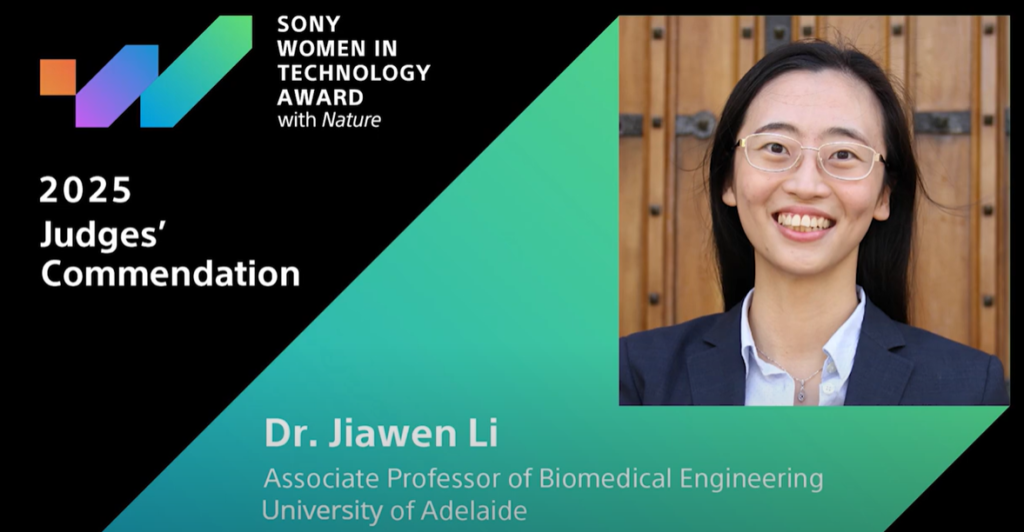
Asian Aussie Business | For her expertise in biomedical engineering, University of Adelaide Associate Professor Jiawen Li has received a renowned worldwide prize from electronics powerhouse Sony and scientific publishing organization Nature.
Working at the University of Electrical and Mechanical Engineering and Institute for Photonics and Advanced Sensing, Associate Professor Li is the only person in Australia and among only four women innovators globally acknowledged in the first Sony Women in Technology Award with Nature.
Following high-calibre applications, the judges’ panel chose to award Associate Professor Li, an early-career researcher spearheading the University’s multimodal imaging and sensing initiative, special Judges’ Commendation distinction.
Accepting the honor and appreciating all the people who have helped her efforts, Associate Professor Li said it was a great honour.
“My work involves using modern engineering techniques to address complex biomedical challenges,” said Associate Professor Li.
“In this industry, teamwork is absolutely vital. By means of close cooperation among doctors, biologists, physicists, chemists, and engineers from many backgrounds, we can pinpoint important unmet requirements in medicine and create quite creative, pragmatic, and deployable solutions.
“I have had great fortune along my career to have men and women who support women in STEM as mentors. Their direction and support have helped me to realize that I need not “make myself invisible” to adapt into a male-dominated setting.”
Although more women are enrolling in STEM courses at universities, under representation in STEM-qualified employment has not yet been corrected.
Combining optical fibre technology with nanoscale 3D printing, Associate Professor Li’s study produces a hair-thin endoscope cardiologists can use to investigate blood arteries to ascertain a patient’s risk of a heart attack. Furthermore applicable for prevention and tailored therapies is this creation.
Along with her associates, Associate Professor Li is extending the multimodal technology’s capabilities to measure data including site-specific temperature and chemical changes as well as investigating uses in neurology and IVF.
Associate Professor Li was congratulated on her award by Professor Anton Middelberg, Deputy Vice-Chancellor (research) University of Adelaide.
Professor Middelberg said, “Associate Professor Li’s world-class research is a shining example of the University of Adelaide’s commitment to find solutions to society’s challenges.”
“This award adds to Associate Professor Li’s outstanding array of accomplishments and funding which show the influence of her work.
“Associate Professor Li’s dedication to see her creative research help as many people as possible is shown by her attempts to commercialise it.
“We are pleased to have Associate Professor Li among our community of researchers here in Adelaide who create history with every new discovery, so accelerating human progress and improving our planet.”
Associate Professor Li joins Dr Kiana Aran, a professor of bioengineering and medicine at UC San Diego; Dr Amanda Randles, a computational scientist biomedical engineer from Duke University and Dr Yating Wan, an Assistant Professor at King Abdullah University of Science and Technology, (Saudi Arabia) who also received awards.
Said Hiroaki Kitano, CTO of Sony Group Corporation and executive sponsor of the initiative, “We started this award in March 2024 with the very clear intention of supporting more diverse gender representation inside the international research community.”
” Our honorees, each of which questions the present level of the art in their professions, really motivate us. Promoting their work and expanding the program going future excites us as well as challenges.
Associate Professor Li got her honor at a Sony headquarters in Tokyo, Japan event.
The Sony Women in Technology Award with Nature website offers further details.
Sources: University of Adelaide